According to the defenders of public education (falsely so called), one of the crimes committed by home educators against their students is the children are not being educated. Of course, this accusation begs the question: what does “being educated” mean? Whenever I am asked what is the mark of an educated person, I respond without hesitation: “An educated person is one who loves to read and who appreciates classical literature.” Included under literature are the belles lettres, history (not textbooks), and languages, modern and ancient.
Forget the math and sciences and other nonsense. These disciplines contribute nothing to living the good life and are useful only to get someone a job. On the other hand, if you are incapable of appreciating works like A Tale of Two Cities, Odyssey, or The Scarlet Letter, or if you fail to find pleasure during an hour sitting reading a book, then you possess an empty soul and cannot claim to be educated regardless of the number of degrees behind your name.
However, not just loving to read, obviously educated people understand what they read. The public schools are incapable of producing readers with their flawed pedagogy of textbooks, rote memory, and objective tests for their students. Many decades of governmental instructed students have been weighed in the balances and found wanting, most not able to understand what they read. Once while I was a professor at a college, I had a student read a passage from the Iliad. After he finished, I said, “Okay, tell your classmates what Homer was addressing in this passage.” The student remarked, “I don’t know; I just read.”
At this college where I taught, students were required to take a placement exam. If scoring poorly on the exam, students were enrolled in a “developmental” class for reading and writing, in which 40% of the entering freshmen had to take before they could take “real” literature courses. Clearly, these students were cheated by their public school systems. It is no small wonder that many people do not read books anymore. If you do not understand what you are reading, then reading is a colossal waste of time. You may as well scroll through your TicTok or Instagram feed.
But I cannot blame the students. Their English courses in high school shortchanged the students of reading quality books written in an elevated language, one distinctive of great literature. The student needs to have a better than average vocabulary in order to do well on college entrance and placement (see developmental course above) exams. But usually trite novels or modern short stories are offered, using common street language, such as The Catcher in the Rye. It should go without saying that to understand what you read, you must master the complexities of language. Without this mastery, you will miss the meaning and ideas of the author.
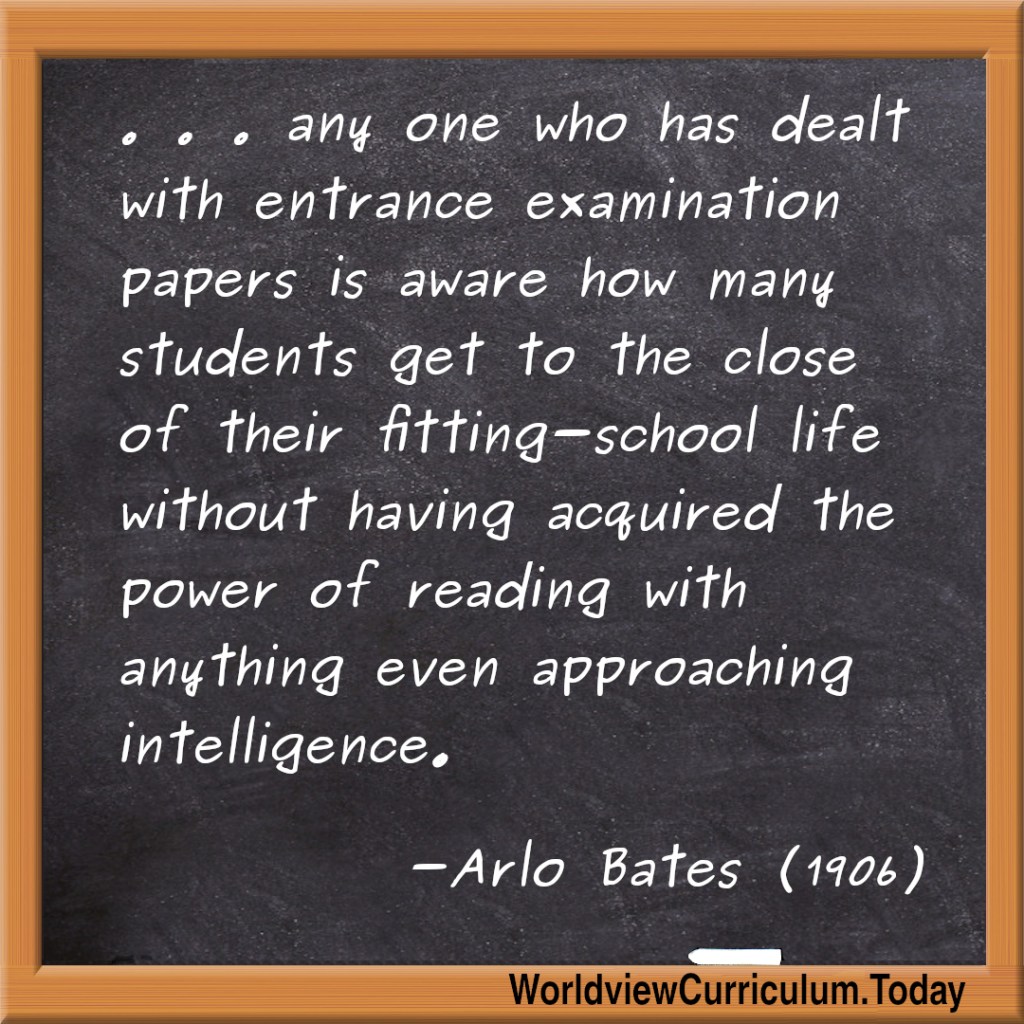
However, as every educated person knows, literature is an art form; and since it is art, literature must be experienced, not learned. In short, no teacher can teach literature; the student must experience it personally by reading. The error promulgated throughout the schools is assigning language arts and history classes as academic courses, material to be mastered with rote answers. In the case of literature and history, the measure in the schools is all wrong. Over a century ago Professor Arlo Bates of MIT stated literature should be measured by the amount of pleasure it gives to the reader. I cannot think of a better way to kill pleasure than having students memorize tidbits about a story, poem, or history only to regurgitate the fluff on a test. According to Bates, “Art is the ministry of joy, and literature is art or it is the most futile and foolish thing ever introduced into the training of the young.” So true, and a lot of joy has been robbed from children over the past hundred years.
I am not saying that your seven-year-old ought to be able to discuss intelligently the tragic flaw of King Oedipus, or the structure of Tennyson’s Idylls of the King, or the significance of Satan’s stating “Better to reign in Hell, then serve in Heav’n” found in Milton’s Paradise Lost. However, children need to start reading as soon as possible in order to have this ministry of joy. If you have older students, I suggest these students read aloud to their younger brothers and sisters as a sort of story hour if you please. You will have the older students performing their reading assignments, while the younger students will become acquainted with the great literature of the past. Between the covers of great literature students will have the pleasure to experience hundreds of relatable characters, every emotion common to all, and the world’s most profound ideas for life written by the world’s greatest writers and thinkers. For home-schooled students, reading books—lots of books—is the primary indication of their being educated, which will put them light years ahead of their peers in the public and most independent schools.

 THE DUNCE'S CORNER
I’ve spent more time with the classics as an adult then I did in my formal education. And I do enjoy the classics, if anything for the often surprising grimey dirtiness of it. My experience about what is and is not literature is that the educated elite (sometimes wealth, sometimes literary elite) are defining what is and is not. There is always an expectation of quality, but inclusion on the syllabus is about that in-crowd.
All of this is to say that the quality of a piece matters, but being missed by that literary elite, doesn’t mean it doesn’t have value.
What you are saying is right, get out there and read. If someone thinks that tawdry romance or violent fantasy are not appropriate, than Ovid and Homer need to come off the syllabus too.
LikeLike