
In my book Critique of Pure Education, I posit that the only legitimate institution capable of educating anyone is the home. Unfortunately, civil governments usurp this natural right from parents by fiat. Compulsory attendance laws coupled with confiscatory taxation compels most timid souls to hand their children over to only God knows who. I am truly puzzled why someone has not made the case that forcing children to go to any school violates the Thirteenth Amendment regarding involuntary servitude. If being compelled against your will to sit in a room full of immature inmates five days a week is not slavery, then what do you call it when children are forced to sit still, to stop talking, to stop daydreaming, and are told to get busy with seatwork? All of this is contrary to the nature of children, most especially young ones, who should be expending all their pent up energy outdoors.
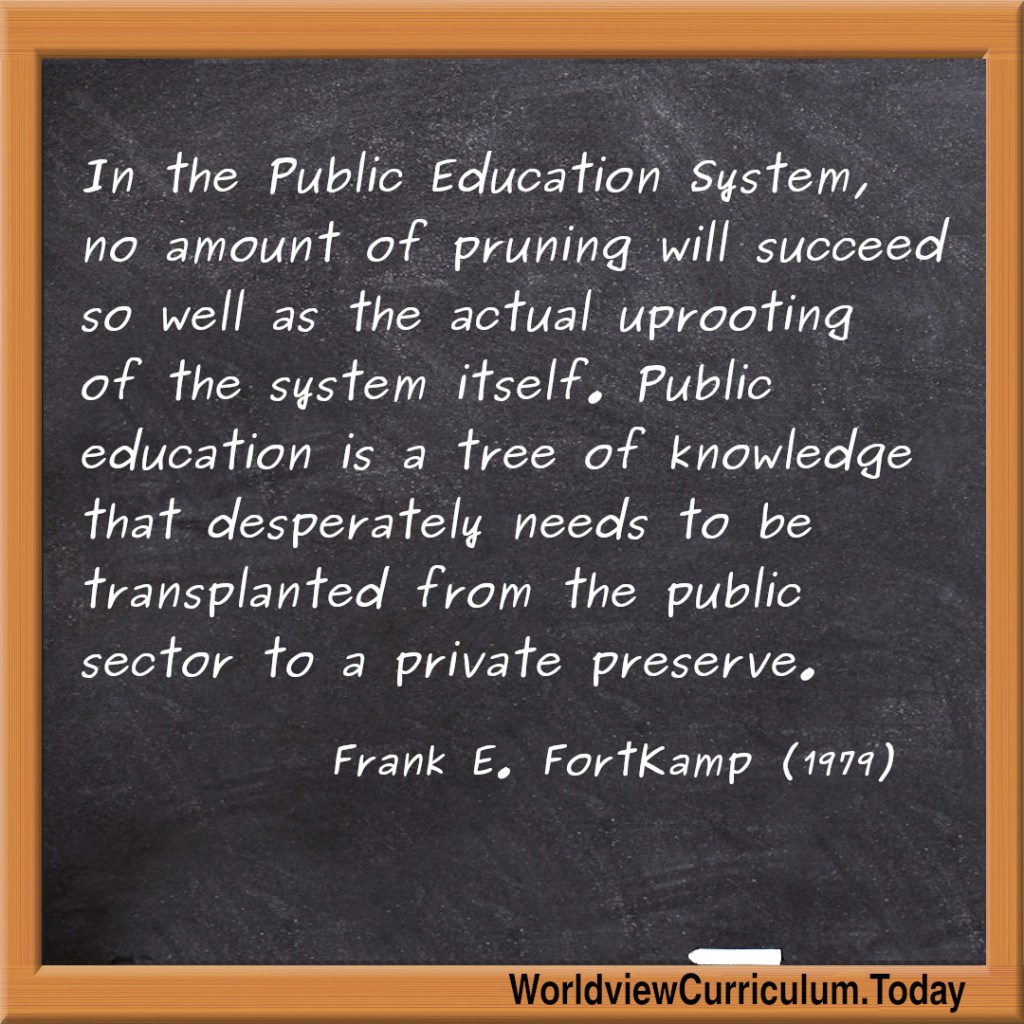
Back in 1980, while a student at Bob Jones University, I happened to discover an interesting book in the school’s library. Not surprising, right? But this book had an intriguing title. The book was newly published in 1979 by Frank E. Fortkamp, titled The Case Against Government Schools. The subtitle says it all: Getting Politics Out of Education and Education Off Your Tax Bill. In short, Fortkamp advocated the separation of school and state, that is, education and governance are separate and incompatible spheres that should not be joined together. Furthermore, the joining of civil government with education will fail to have a good result, because liberty is at risk. However, while my argument against governmental schools points to natural law, Fortkamp’s central argument derives from economics, which is a valid one. Education is a commodity, Fortkamp points out, just like any other good or service, and therefore education should compete in the free market, which encourages and ensures competition for better products. On the other hand, the current socialistic system with its brute force and theft from property owners offers no incentive to be economically efficient, let alone to produce a superior product.
When Fortkamp wrote his book over forty years ago, home schooling as a movement was in its initial stages. Most states frowned upon parents educating their children at home well into the 1980s. Then with the help of HSLDA, the efforts of parents, and the favorable outcomes of several cases in the courts, state legislators began enacting laws to recognize home schools, if not legitimate in themselves, at least as schools existing as private institutions. Nevertheless there are still today many states where the government interferes with parental liberty in some form, whether approving curriculum to be used, mandating the number of days of “school,” or even the qualifications of parents to teach. Some states like Georgia require a goodly amount of paperwork and mandate standardized tests for home scholars at different intervals. Regardless how benign or how minimal the burden imposed by the civil government with regards to a child’s education, it still remains an intrusion by bureaucrats in an area they have no business at all.
Of course, I can hear the cries: “What about the poor who can’t afford education for their children? If there isn’t any public school, how will they learn anything?” This is a specious objection. The current model of education guarantees stupidity and poverty; public education is the poorest citizen’s worst enemy. Time prevents me to develop this thought at the moment; however, just a little research on the internet will reveal the plight of the poorest school districts in the country. While there are some successful charter schools in depressed neighborhoods, these are the exception, not the rule when governmental funding is concerned. Please note how these successful schools are under attack by groups like the NAACP. Go figure.
Of course, the whole problem with government schools can be summed up in two words: stinking socialism. When are Americans going to learn that a government using a socialistic scheme is incapable of providing quality goods and services, especially educational services? After all, isn’t this the same gang that has given us the delightful spectacles of the COVID fiasco, of worthless paper money, and of dozens of no-win wars against poverty, drugs, and terrorism? How much spending will be required before everyone says no more?
Frank E. Fortkamp is entirely correct when he advocates for the separation of school and state. While I applaud the efforts and good intentions of parental and academic organizations taking the fight to school boards across the country, in the end, these groups will discover they are on a fool’s errand. Elimination of teachers’ unions (unlikely), school choice, better and responsible school boards, new teaching methods, even augmenting the Bible with prayer—none of these notions will solve the problem so long as the government compels citizens to support—with their children and money—something the bureaucrats are incapable of performing, that is, education. No amount of reforms or common sense will solve the central issue in the public schools. This is because the government’s meddling, whether at the local, state, or federal level, is an illegitimate role for civil government. Period.
The current activists trying to reform the schools for whatever reason would be better off using their energy and resources toward eliminating government schools completely, state by state, just like homeschooling advocates worked actively in the state legislatures in the 1980s. However, maybe with the continued exodus of teachers and students from the public system, we could very well see the deterioration of the public schools to the point of their own collapse. Like I said, “Maybe.” We can only hope so.
 THE DUNCE'S CORNER