
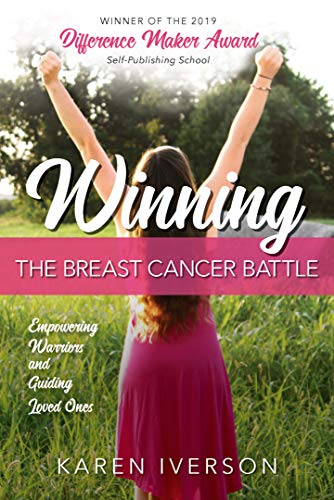
Receiving the “Difference Maker Award for 2019,” Winning the Breast Cancer Battle by Karen Iverson is a fascinating book, and I highly recommend it to those who are diagnosed with breast cancer, to those who are their caregivers, and to those who want to relieve the suffering of others. Admittedly, I generally do not read books about the issues of breast cancer. In fact, this is my first. With so many other books to be read, and in the case of the classics, to be read again, I do not see the profit or the relevance of taking valuable time to read about something that may never be applied to my own life.
Also, and more importantly, I shy away from autobiographies. I recently reviewed two such works: one about a fellow’s struggle with mental illness and the other about a lady’s story about her heart disease. Almost always without exception after reading any autobiography about an author’s suffering from this or that problem is my asking the question, “Yeah, but so what?” Everyone has a story to tell about ups and downs in life. I can just imagine the hundreds of readers of an autobiography saying, “Man, that ain’t nothing; let me tell you what happened to me!” The cold, cruel fact of the matter is no one wants to read about a personal account unless the author offers some value to the reader in exchange for the time reading. Karen Iverson happily gives to the reader a lot of value.
Instead of pages and pages of paragraphs, the author uses the motif of journaling. Thoughts are very personal, penetrating, and honest. Sometimes there are whole paragraphs, but more often than not, the author offers short quips; sometimes there is only one sentence on the entire page, that sentence rich in meaning and insight. Needless to say, this moves the story along quite nicely. In addition to the journal entries about her thoughts and emotions, the author provides a template, a how-to-do-it manual, if you please. She has sections containing tips at the end of each chapter, for an example, “Things families, friends, and caregivers can do” appears among these tips. Also, throughout the book, the author has information to get free downloads of checklists, forms, questions to ask the doctors, and other resources. This material is most helpful.
What I learned from reading this book was not how I should deal primarily with breast cancer. My chances of getting this disease is—while possible—very slight. Maybe I will later have a close friend who will suffer from this illness. So yes, now I have a resource to at least understand and help. However, more importantly this book helped to remind me what Plato said so many years ago: “Be kind to everyone you meet, because everyone is fighting a battle.” While the tips and free handouts certainly have value, the greatest value is the author’s directing the reader’s attention to the fact that this world is filled with hurting, frightened souls who are merely showing a brave face. I will try from now on to look past the face and directly into the eyes of everyone. There I can begin to empathize and understand, offering help, if and when needed. Karen Iverson has done what few authors have done: she has taken a personal experience and universalized it for all souls experiencing pain from whatever source.
 THE DUNCE'S CORNER