
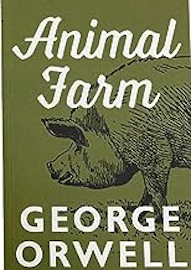
There are certain books I read every three to five years. Of course like all great literature, these volumes lend themselves to rereading, and I always notice and learn something new as a result of this, this too being a mark of truly great literature. Recently, I finished rereading Animal Farm by George Orwell. If you have never read or it has been awhile since you read this short work, you owe it yourself to do so. You can even download a free study guide for Animal Farm here.
When Orwell (a.k.a. Eric Blair) wrote Animal Farm, the world was catching its breath after several years of war. The novella is a fable in the sense that animals in the book talk and act as though they are human beings. Early in the story about a farm, the animals have enough of their being abused, rebel against the humans, and win their “independence.” Like Aesop, Orwell packed a lot of meaning and lessons into his fable. However, the moral to the story is vague unless one argues that citizens should not replace one bad deal with something worse.
Most commentators explain that the central purpose of Animal Farm is to critique the failure of the Soviet state and to chronicle the internal conflict between Trotsky and Stalin. Even though he castigates the Soviet version of socialism, Orwell was an argent socialist himself, who believed that the socialism in the Soviet Union was a corruption of Marx’s ideals. However, Orwell believed that socialism was still the answer to the world’s problems of misery and oppression, as many other writers did like F. Scott Fitzgerald and John Steinbeck.
Yet, even though Orwell may not have intended it, Animal Farm is not just a condemnation of the Soviet system of socialism, or even of totalitarianism in general as manifested in its fascistic, capitalistic, or socialistic forms. After all, these systems are not forms of civil government, but rather economic systems. What Animal Farm demonstrates is the failure of the political entity called the state. The state as a civil government is unable to offer or to maintain liberty, because the interests of the state are counter to the interests of liberty.
As Animal Farm makes abundantly clear, the state is a criminal enterprise. It makes no difference whether the state is “totalitarian” or “democratic.” One state may be a little less criminal than another state, but any state will become despotic and oppressive if it is given the power to do so. The animals living on Animal Farm willingly give more power to the pigs (the elite on Animal Farm), and soon they find themselves in worse conditions than before their “glorious revolution.” On the other hand, the pigs live in ease and luxury, bending the rules to suit them. One lesson seldom learned is when citizens give power to the state to do something for them, they give power to the state to do something to them as well. The founding fathers never intended to create a state under the U.S. Constitution. An excellent article about the early attitudes in the United States regarding the roles and limits of civil government can be read here.
Indeed, the founding fathers did not trust the state to be a friend of liberty. After all, the founders had just finished a protracted war with a despotic British state, and most of these men had no desire to put themselves under another despot. Our founding fathers tried—but failed—to ensure no American state would ever be formed from the thirteen independent nations in North America. One of the most vocal of the opponents against the U.S. Constitution was Patrick Henry, who prophetically stated that many prominent men of his day “…object to this government for its consolidating tendency. This is not imaginary. It is a formidable reality. If consolidation proves to be as mischievous to this country as it has been to other countries, what will the poor inhabitants of this country do? This government will operate like an ambuscade. It will destroy the state governments, and swallow the liberties of the people, without giving them previous notice.”
Unfortunately, Patrick Henry was absolutely correct. Unprincipled men began from the beginning to test the bounds of the Constitution, and the flaws became evident as industrialists and bankers in New England gained control of the Northern political machines and used their money to weaken the Constitutional intent.
While George Orwell may have had the Soviet Union in mind, Animal Farm is also a concise history of the United States starting with liberty (War of Independence), to the consolidation of power (under John Marshall, Henry Clay, and Abraham Lincoln), to the waging of war against those who would not submit to the American state (conquest of the Confederate States of America, the plains Indians, and the Filipinos), and currently to its despotism towards everyone who opposes the Woke/Cultural Marxism of the self-appointed gatekeepers of “truth” who use cancellation and nullification as weapons. Reading Animal Farm will help everyone to gain wisdom from history and perhaps will even spark a longing within our souls again. Instead of being slaves to the state, to the banks, and to the international corporations, perhaps it is time for all Americans to try liberty again.
 THE DUNCE'S CORNER