
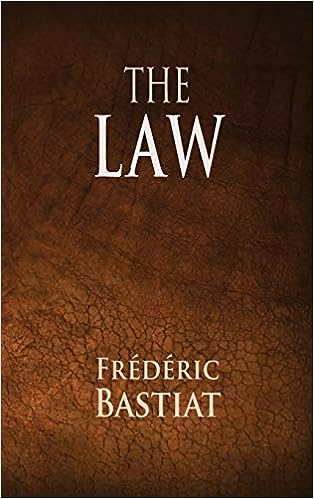
THE LAW by Frederic Bastiat is the definitive work on the nature and purpose of legislative laws. After having read this book recently for the fifth time in my life, I have always experienced a new appreciation for Bastiat’s insight into the nature of human beings and their government. If you have never read this short book before, you can down a pdf copy here. This book explains concisely and clearly that the great aim of civil law is TO PROMOTE the greatest amount of liberty. If a government truly valued liberty, one would think that every student in the country would be given this small volume and be required to read it at least once a year. But since this is not the case in the United States today, this lack indicates liberty and freedom are not very important values in the school systems or in American life generally.
As Bastiat points out, the rights of life, liberty, and property are God-given gifts which were established long before any legislation by human governments. However, since men are sinners and will maliciously take away these gifts from others, God ordained government to be the minister of justice. The central theme of the Bible is the redemption of God’s creation. And part and parcel with any idea of redemption is the satisfying of a judgment and the escaping from bondage. Therefore, God intends for liberty, not slavery, to be the norm for all humankind.
Whether to live your life as you see fit, to raise your own children without outside interference, or to follow your vocation by employing your talents and gifts, true liberty must always be connected with the liberty under a sovereign God, who redeems mankind and his creation. However, according to Bastiat, instead of guaranteeing liberty, the law in every nation is used to oppress and to subjugate the citizens from exercising liberty. Even though he uses human reason to make his case for liberty, Bastiat nevertheless reflects the biblical viewpoint of law. As a Frenchman, Bastiat saw firsthand in the 1840s what happens to a country that rejects its religious mores and substitutes them for socialism and rationalism. The result is a flawed worldview that insists that society cannot exist without a centralized state. Once the state (now the law-giving god) becomes omnipotent, the citizen will be subjugated to abject poverty and slavery.
Bastiat’s thoughts are still relevant for us today in the ongoing social and cultural war. As the state achieves the status of a god, who claims to provide for all equally, fairly, and justly, and has the power to enforce its will upon the citizens, the church and the home become irrelevant in such a society, as is clearly seen in the United States today. The trite cliché, “We still live in the freest country in the world,” is wearing thin. The United States has lost its right to be the standard for liberty and especially, morality many years ago. Like the proverbial frog in a pan of water, we who were always in the water cannot tell that the temperature is slowly rising. We must first get out of the water and then view the situation from outside the pan.
Bastiat’s The Law helps us to take an objective look at our present enslavement. You as a member of the human race need to thoughtfully read and study this book. You will be reading a most timely message that can solve just about every social, economic, and political problem that mankind has, except of course the issue of sin in the individual. The only hope for the United States and other nations across the world is for legions of young and old to renounce the socialistic experiments of the past 200 years and to give liberty a chance once again. Reading Bastiat’s book is a good start towards the reclamation of our souls and minds.

 THE DUNCE'S CORNER